
Quick answer: Fluorescent yellow-green (safety green or lime) is the most visible hi-vis color in most daylight conditions and stands out best against asphalt, concrete and gray skies. Fluorescent orange-red stands out better against green and brown backgrounds like trees, fields and dirt, and in snow. Fluorescent red is also allowed under ANSI/ISEA 107. Whatever the color, retroreflective tape is what gets you seen at night, not the fabric color.
"Lime or orange?" is one of the most common questions we get. The honest answer is that both are ANSI-approved and both work. The better choice depends on what's behind you when a driver or operator looks your way.
The three ANSI/ISEA 107 background colors
The ANSI/ISEA 107 standard allows three fluorescent background colors for high-visibility safety apparel:
| Color | Also called | Stands out best against | Common users |
|---|---|---|---|
| Fluorescent yellow-green | Safety green, lime, hi-vis yellow | Asphalt, concrete, urban settings, dawn and dusk sky | Road crews, construction, utilities, parking and traffic control |
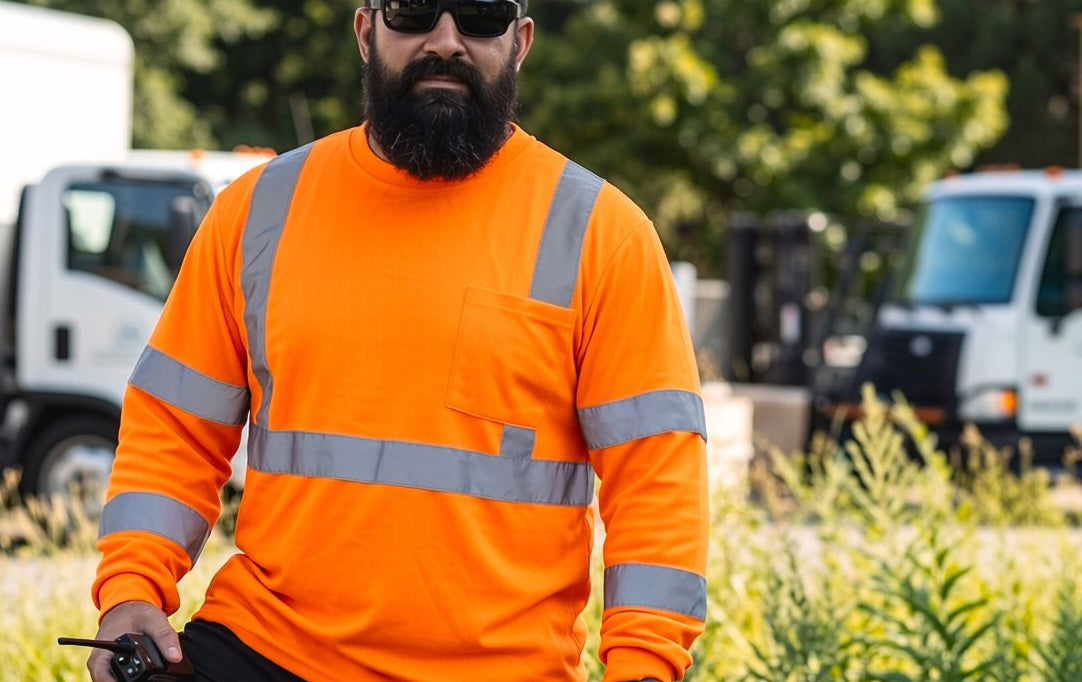
| Fluorescent orange-red | Safety orange | Green foliage, dirt, snow, sand | Landscaping, forestry, rail, winter crews, surveyors |
| Fluorescent red | Hi-vis red | Low light and some rural backgrounds | Less common, sometimes used to tell roles apart |
Why yellow-green is usually the brightest
The human eye is most sensitive to light in the yellow-green part of the spectrum, especially in daylight. So fluorescent yellow-green reads as the "brightest" color to most people and is the default for road work in much of the U.S. It also contrasts with orange cones, barrels and signs, so workers don't blend into the traffic control devices around them.
When orange is the better choice
- Green backgrounds: landscaping, parks, golf courses, orchards, forestry. Lime can blend into bright green foliage. Orange pops.
- Snow: yellow-green can wash out against snow and glare. Orange holds its contrast.
- Sand and dirt: earthmoving and desert work often favor orange.
- Company or site rules: some utilities, railroads and GCs specify one color so crews look uniform. Always check the site spec first.
Color gets you seen by day. Reflective tape gets you seen at night.
Fluorescent fabric works by converting UV light into visible light, so it's brightest in daylight, dawn and dusk. After dark it does almost nothing. At night you're relying on retroreflective tape, which bounces headlights back to the driver. That's why ANSI Class 2 and Class 3 garments specify minimum amounts of both background fabric and reflective material. For night work, read our guide to hi-vis layering for night shift.
Shop by color
Most of our ANSI-rated pieces come in both safety green and safety orange, so you can match your site spec:
- ANSI Class 2 Hi-Vis Safety Vest with 4 Pockets: green or orange, S-5XL
- Short Sleeve Hi-Vis Safety T-Shirt: lightweight mesh polyester, 2-inch reflective stripes
- Hi-Vis Long Sleeve T-Shirt with Front Pocket: ANSI Class 3 long-sleeve coverage
- Hi-Vis Class 3 Zip-Up Windbreaker: for wind and light rain
Or browse everything rated in ANSI Class 2 and ANSI Class 3.
What about safety-colored cotton tees?
Blank tees dyed safety green or safety orange, like our Jerzees 363M Safety Color Tee, are bright and great for crew identification, printing and general visibility. But without reflective tape and certified fabric they are not ANSI 107 compliant. Use them where a rated garment isn't required, or under an ANSI vest. More on that in ANSI 107 explained.
What about black hi-vis?
Some "black bottom" garments use black on the lower panels to hide dirt while keeping fluorescent fabric up top. Black itself isn't a hi-vis background color, so the rest of the garment must still meet the minimum fluorescent and reflective area to be rated. Always check the label for the ANSI class.
FAQ
Is lime or orange more visible?
In most daylight urban and roadway settings, fluorescent yellow-green is more visible. Against green vegetation or snow, orange usually wins.
Can I mix colors on one crew?
Yes, all three colors are ANSI-compliant. Many companies use one color for general crew and another for flaggers or supervisors so roles are easy to spot.
Does hi-vis fade?
Yes. UV and washing slowly dull fluorescent fabric. When it looks noticeably faded next to a new garment, it's time to replace it. See how to keep hi-vis bright longer.
Share:
Camo Hooded Shirts for Work and Hunting: What to Look For (and When Not to Wear Camo)
How to Prepare Your Logo File for Custom Shirt Printing (So It Prints Right the First Time)