
ANSI Class 2 Shirts with Logo: A Practical OSHA-Ready Buying Guide
If you're responsible for crews in construction, warehousing, utilities, transportation, or field services, you live in the tension between three things: keeping people safe, staying OSHA-compliant, and staying on budget.
High visibility work shirts are one of the simplest controls you can standardize—yet they're also one of the easiest places to cut corners and create risk.
This guide walks you through exactly what ANSI Class 2 and OSHA-compliant company shirts are, how to choose the right ones, and why upgrading to ANSI Class 2 shirts with logo from a specialist like SafetyApparel protects your people and your company.
What "ANSI Class 2" and "OSHA Compliant" Really Mean
Before you approve another order for hi-vis shirts, it's worth aligning on terminology. Vendors often throw around phrases like "ANSI compliant safety shirts" or "OSHA compliant uniforms" without explaining what's actually behind those claims.
ANSI vs. OSHA: Who does what?
ANSI/ISEA 107-2020 is the technical standard that defines high-visibility safety apparel in the U.S. It specifies:
- Minimum amounts of fluorescent background fabric
- Required amounts and placement of reflective tape
- Approved hi-vis colors and labeling requirements
OSHA doesn't manufacture garments or issue its own hi-vis spec. Instead, OSHA expects employers to follow recognized consensus standards (like ANSI/ISEA 107) under:
- 29 CFR 1926 construction rules (including flaggers and roadway work)
- 29 CFR 1910.132 (general PPE)
- The General Duty Clause (your obligation to control recognized hazards)
So when you see "OSHA compliant company shirts" or "OSHA compliant uniforms", what really matters is whether the garment meets ANSI/ISEA 107-2020 for the right type and class.
What exactly is an ANSI Class 2 shirt?
An ANSI Class 2 safety shirt is designed for workers who are exposed to moving vehicles or equipment where speeds are often in the 25–50 mph range or where the background is visually complex (busy job sites, cluttered yards, traffic, etc.).
To qualify as an ANSI compliant safety shirt – Type R Class 2, a garment must, among other things:
- Use approved fluorescent background fabric (typically yellow‑green or orange‑red)
- Provide at least 775 in² of fluorescent background area
- Provide at least 201 in² of retroreflective or combined‑performance material
- Place reflective material for 360° visibility (wrap-around body bands plus vertical shoulder bands)
- Be labeled inside with the standard (for example,
ANSI/ISEA 107-2020 Type R Class 2), size, care instructions, and manufacturer ID
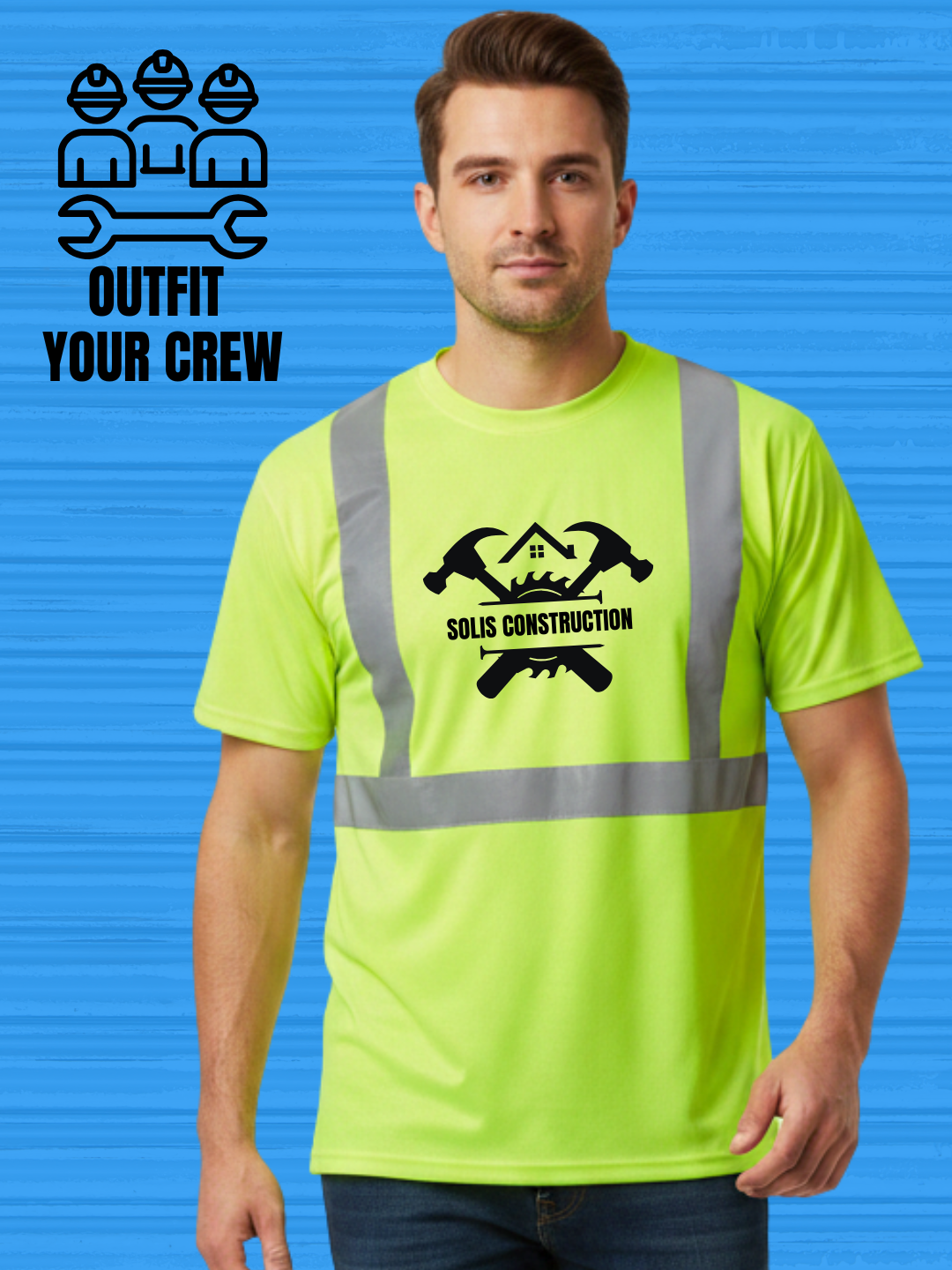
When you order ANSI Class 2 shirts with logo, you're getting that technical visibility performance plus your company branding on top.
When is Class 2 the right choice?
Class 2 high visibility work shirts are typically appropriate for:
- Road and bridge crews near traffic but not necessarily in freeway-speed zones
- Construction laborers and operators on active sites
- Warehouse and yard workers around forklifts, yard trucks, and material handlers
- Utility workers in rights-of-way or along streets
- Field technicians entering customers' properties or working curbside
For higher speed roads, night work, or extremely complex work zones, Class 3 may be the better call. But for many operations, standardized Type R Class 2 shirts are the everyday workhorse.
Why OSHA-Compliant Company Shirts Are a Smart Risk-Control Tool
If your crews are already wearing some form of bright shirt or vest, why invest in OSHA compliant company shirts that are properly rated?
1. Reduce incident risk from vehicle and equipment strikes
Struck-by incidents remain one of the leading causes of serious injuries and fatalities in construction and industrial environments. High-quality hi-vis shirts with company logo that are truly ANSI-compliant:
- Make workers visible from further away, in more conditions
- Outline the human form with reflective tape, so operators recognize a person, not just a color patch
- Support safer decisions by drivers and equipment operators with earlier reaction time
2. Strengthen your compliance story
When something goes wrong, OSHA and insurers will ask two questions:
- Was there a recognized hazard? (Moving vehicles, blind spots, public traffic, heavy equipment.)
- Did you use feasible, effective controls? (Including proper PPE like ANSI compliant safety shirts.)
Documented use of ANSI/ISEA 107-2020 Type R Class 2 garments across your crews is an easy way to show you've adopted current best practice—not just whatever was cheapest on a big-box shelf.
3. Standardize PPE across sites and contractors
Without a standard, you end up with a mix of:
- Old vests with worn-out reflective tape
- Random bright T-shirts with no reflective material
- Non-rated hunting camo or fashion "neon" that doesn't meet ANSI
By specifying OSHA compliant company shirts—for example, Type R Class 2 high visibility work shirts from a single vendor—you:
- Simplify ordering and inventory
- Cut down on debates in the field about what's "good enough"
- Make spot-checks and audits much faster (just check the ANSI label)
4. Present a professional, consistent brand in the field
That's where ANSI Class 2 shirts with logo really shine. You're not just checking a compliance box; you're:
- Making your crews instantly recognizable on multi-contractor jobs
- Reinforcing your company identity on customer sites and in public areas
- Sending a visual signal that your organization takes safety seriously
Custom logo safety shirts combine safety, compliance, and brand—without adding complexity for your foremen.
How to Evaluate High Visibility Work Shirts (Without Becoming a Fabric Expert)
You don't have time to become a full-time PPE specialist. Use this simple framework when comparing high visibility work shirts and OSHA compliant uniforms.
1. Start with the label: is it truly ANSI/ISEA 107-2020?
Inside the garment, you should find a label that clearly states something like:
ANSI/ISEA 107-2020 Type R Class 2
If the label doesn't show the standard, type, and class, you should assume the shirt is not an ANSI compliant safety shirt—no matter what the product title says.
Quick questions for your supplier:
- Do your hi-vis shirts carry an ANSI/ISEA 107-2020 label?
- Are they Type R Class 2 or a different type/class?
- Can you provide a spec sheet confirming background and reflective material areas?
2. Check the fabric: comfort vs. durability
Your crews won't wear what they hate. Look for:
- Lightweight, breathable knits for hot weather
- Moisture-wicking fabrics to reduce sweat and heat stress
- Soft hand-feel that doesn't feel like plastic or cardboard
- Good colorfastness—fluorescent colors that hold up to washing and sun
Specialty options include:
- FR (flame-resistant) ANSI Class 2 shirts for electrical, refinery, or hot work
- Long-sleeve high visibility work shirts for sun or arc-flash layering
3. Reflective tape layout and quality
Not all tape is created equal. Look for:
- 2" wide reflective tape (common, and exceeds minimums)
- 360° banding around the torso
- Vertical shoulder stripes to outline the human form
- Secure stitching that doesn't unravel after a few washes
Cheap garments often cut corners with narrow tape, poor placement, or low-quality reflective material that dulls quickly.
4. Fit and range of motion
Hi-vis only works if it's worn over the parts of the body workers actually move.
Consider:
- Generous but not sloppy fit to accommodate base layers
- Side slits or flexible fabric so bending, reaching, and climbing ladders feels natural
- Size runs that actually match your crews (including larger sizes many general retailers skip)
5. Logo application that doesn't compromise compliance
Adding your logo shouldn't negate ANSI compliance. With the right partner, ANSI Class 2 shirts with logo stay fully compliant.
Look for a specialist who:
- Knows how large a logo can be before it affects the required background area
- Uses heat transfer or screen print methods that don't damage reflective tape
- Places logos in areas that preserve reflective patterns and visibility
Safety-focused suppliers like SafetyApparel are built on this exact expertise—custom logo safety shirts and hi-vis shirts with company logo that meet ANSI/ISEA 107 while showcasing your brand.
When to Choose Shirts vs. Vests vs. Other Hi-Vis Options
You may already provide safety vests. So when does it make sense to standardize on high visibility work shirts instead of, or in addition to, vests?
Benefits of hi-vis shirts for daily wear
- Better compliance – When the hi-vis is the shirt itself, workers can't "forget" their vest in the truck.
- Less snag risk – No extra straps, buckles, or loose edges.
- More professional look – Especially when you're using hi-vis shirts with company logo.
- Comfort – For many workers, a breathable hi-vis T-shirt is more comfortable than a vest over standard clothing.
When vests still make sense
- Visitors, short-term subs, or drivers hopping in and out of cabs
- Situations where workers may need to don hi-vis over other specialized gear (for example, harnesses, FR coveralls)
Step-by-Step: How to Standardize Your ANSI Class 2 Shirts with Logo
You don't need a giant PPE committee to get this right. Here's a simple rollout roadmap you can follow in a week or less.
Step 1: Identify roles that need Class 2 coverage
List the roles that work:
- In or near live traffic
- Around forklifts, yard trucks, or heavy equipment
- In large yards, plants, or warehouses with blind corners
- On customer property where professional appearance matters
Most organizations quickly identify:
- Construction laborers, operators, spotters
- Warehouse pickers, loaders, and yard staff
- Utility or telecom field techs
- Delivery, service, and maintenance crews
These are your core groups for Type R Class 2 high visibility work shirts.
Step 2: Decide on seasonality and fabric mix
Based on your climate and work, choose a mix such as:
- Short-sleeve ANSI Class 2 shirts with logo for warm months
- Long-sleeve ANSI compliant safety shirts for sun exposure or layering
- FR-rated options for crews around electrical or hot work
Step 3: Set a company standard (simple, written, and enforceable)
Create a one-page standard that says, in plain language:
- Which workers must wear OSHA compliant uniforms (and when)
- That garments must be ANSI/ISEA 107-2020 Type R Class 2 (or higher) and logoed company shirts where provided
- How frequently shirts are replaced (for example, after a set number of washes or when fading/damage is visible)
Step 4: Choose a specialist vendor, not a generic T-shirt shop
A local print shop can put logos on bright shirts. But only a safety-focused provider truly specializes in:
- ANSI compliant safety shirts in multiple styles and fabrics
- Custom logo safety shirts where branding does not compromise compliance
- Size runs and inventory options designed for crews, not for retail
- Guidance on OSHA expectations and documentation to support your PPE program
This is especially important when you're ordering large volumes of ANSI Class 2 shirts with logo across multiple locations.
Step 5: Pilot with one crew, then roll out
Start with a single crew, project, or warehouse:
- Issue them hi-vis shirts with company logo from your chosen standard
- Get feedback on fit, comfort, and durability after a few weeks
- Make any small adjustments (for example, fabric weight or sleeve length) before scaling
Then extend the same standard to other sites, so the entire company is aligned on one set of OSHA compliant company shirts.
How SafetyApparel Simplifies Buying OSHA Compliant Uniforms
SafetyApparel focuses specifically on high visibility work shirts and related hi-vis gear. For safety managers and operations leaders, that specialization means:
1. Pre-vetted, ANSI-compliant product range
You don't have to guess which garments are legitimate. Our hi-vis line is built around:
- ANSI/ISEA 107-2020 Type R Class 2 and higher standards
- Quality fabrics that balance comfort, durability, and visibility
- Consistent labeling and documentation, ready for your PPE records
2. Expert logo placement and customization
We help you create custom logo safety shirts that:
- Keep the required fluorescent and reflective areas intact
- Use logo sizes and placements tested across many crews and industries
- Maintain ANSI compliance while giving you strong brand visibility
Whether you call them hi-vis shirts with company logo, ANSI Class 2 shirts with logo, or OSHA compliant company shirts, the goal is the same: protect your people while making your brand look sharp.
3. Volume-friendly pricing and new-customer savings
We know you're managing budgets. That's why we offer:
- Volume discounts when you standardize across crews or locations
- New-customer discounts so you can trial our gear without blowing your PPE budget
- Fast, practical support from people who understand your world, not just sales scripts
Ready to Upgrade Your Crews' Hi-Vis Shirts?
If you're planning your next PPE order, this is a good time to move away from random bright T-shirts and mismatched vests.
Browse our selection of ANSI compliant safety shirts in our shop, including:
- Short- and long-sleeve ANSI Class 2 shirts with logo options
- Comfortable, moisture-wicking high visibility work shirts for hot conditions
- Specialty options for crews who need extra protection
We can help you choose the right OSHA compliant uniforms for each role, dial in your logo placement, and take advantage of volume discounts and new-customer discounts.
Take a few minutes to review your current hi-vis program. If you see a mix of faded tees, unknown vests, and inconsistent branding, you're ready for an upgrade.
When you're ready, browse our ANSI Class 2 shirts and reach out—let's outfit your crews with gear that protects your people, your reputation, and your bottom line.
Share:
Big & Tall Hi-Vis Workwear: Getting the Right Fit for Every Worker on Your Crew
Off-Duty Safety: What to Wear When You’re Not on the Job (But Still Around Traffic)