
Class 2 vs Class 3 Safety Vests: What’s the Difference and Which Should You Buy?
When you're working inches from traffic or heavy equipment, what you're wearing can be the difference between a close call and a serious injury.
Yet one of the most common questions we hear at Safety Apparel Zone is:
"Do I really need a Class 3 vest, or is Class 2 enough for my job?"
If you work in U.S. construction, road work, utilities, warehousing, or run a small crew, understanding Class 2 vs Class 3 safety vests is more than a compliance issue. It's about visibility, liability, and getting everyone home safe.
This guide breaks it down in plain language so you can choose the right gear with confidence.
The ANSI standard behind Class 2 and Class 3
In the U.S., high-visibility safety apparel is governed by ANSI/ISEA 107, the standard that sets minimum requirements for things like:
- Amount of fluorescent background fabric
- Amount and placement of reflective tape
- Overall design and coverage
Both Class 2 and Class 3 garments are considered performance classes under this standard. The higher the class, the more visible the garment is intended to be, especially in low light and against busy backgrounds.
At a high level:
- Class 2 vests are designed for moderate risk situations
- Class 3 vests (and jackets) are designed for high-risk situations where you need to be seen as a full human shape from farther away
OSHA often references ANSI/ISEA 107 in enforcement, especially for workers on or near roadways. Learn more at the OSHA PPE official page.
What is a Class 2 safety vest?
A Class 2 safety vest is a high-visibility garment with more background and reflective material than Class 1, but less than Class 3.
Typical uses
Class 2 vests are common for:
- Road construction and maintenance on lower-speed roads
- Utility and telecom crews working on or near shoulders
- Surveyors, inspectors, and general construction staff near traffic
- Warehouse and yard workers around forklifts and trucks
If you're working around traffic moving faster than 25 mph, or near heavy equipment with limited visibility, Class 2 is usually considered the minimum.
Key features of Class 2 vests
- More surface area of bright (fluorescent) fabric than Class 1
- 2" reflective tape around the torso and over the shoulders
- Sleeveless vest design that can be worn over shirts or jackets
You'll find plenty of options in our Safety Vests Collection that are clearly labeled as ANSI/ISEA 107 Type R, Class 2.
What is a Class 3 safety vest or garment?
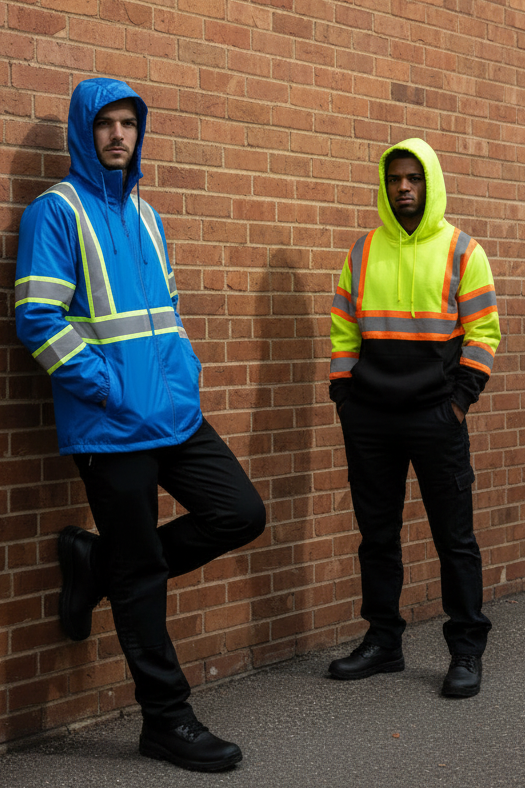
A Class 3 garment provides the highest level of visibility in the ANSI system. Technically, many Class 3 garments are jackets, hoodies, or long-sleeve shirts rather than basic vests, because sleeves are required to get enough visible area.
Typical uses
Class 3 visibility is strongly recommended for:
- Night work or low-light conditions (dawn/dusk, fog, heavy rain)
- High-speed roads and highways
- Flaggers and workers standing in live lanes
- Emergency response or crash-scene workers
Key features of Class 3 garments
Compared with Class 2, Class 3:
- Has more background material (more of your body is covered in hi-vis color)
- Has more reflective tape, including around the arms on long sleeves
- Makes you look like a full human figure at a distance, not just a floating torso
Because of the sleeve requirement, many crews achieve Class 3 by using:
- Hi-vis jackets or hoodies from our Hi-Vis Outerwear Collection
- Long-sleeve hi-vis shirts from our Hi-Vis Shirts Collection
- Or a combination of garments that meet Class 3 as a system
Class 2 vs Class 3: how to choose for real job sites
Scenario 1: Daytime work on a 35 mph suburban road
- Speed: 30–35 mph | Environment: Residential street resurfacing | Light: Daytime
Recommended: Class 2
Type R, Class 2 vests or shirts are typically sufficient. Browse Type R, Class 2 vests in our Safety Vests Collection.
Scenario 2: Night paving operation on a 55–65 mph highway
- Speed: 55–65 mph | Environment: Lane closures, work vehicles | Light: Night, possible rain or fog
Recommended: Class 3
Type R, Class 3 jackets, hoodies, or long-sleeve shirts. Consider hi-vis outerwear from our Hi-Vis Outerwear Collection explicitly labeled as Class 3. The extra reflective area and sleeves help drivers recognize a full person at a distance.
Scenario 3: Large private industrial yard with slow-moving trucks
- Speed: Mostly below 25 mph | Environment: Loading docks, yard trucks, forklifts | Light: Mixed
Recommended: Class 2 (minimum)
Type R or Type O, Class 2 vests are common. Some sites standardize on Type R, Class 2 for simplicity and better visibility. Browse options in our Safety Vests Collection.
Can you mix shirts, vests, and outerwear to reach Class 3?
Yes—what matters is the total visible area your system provides.
For example, a worker might wear:
- A non-ANSI base layer
- A Class 2 hi-vis shirt from our Hi-Vis Shirts Collection
- A Class 3 jacket from our Hi-Vis Outerwear Collection on top
If the outer layer is Type R, Class 3, the ensemble effectively delivers Class 3 visibility (assuming it's worn properly and fully fastened).
Be careful not to:
- Cover a Class 3 jacket with a dark, non-hi-vis raincoat
- Wear backpacks or gear that block large patches of reflective tape
What about Class 2 vs Class 3 for small crews?
Small crews often try to simplify gear decisions. Here's a practical strategy:
-
Standard baseline:
- Type R, Class 2 vests from our Safety Vests Collection for all field workers
- Lightweight hi-vis shirts for summer from our Hi-Vis Shirts Collection
-
"High-risk" kit for certain jobs:
- A set of Class 3 jackets or long-sleeve shirts from our Hi-Vis Outerwear Collection for night work, highway jobs, or bad weather
- These can be stored in trucks or with a supervisor and handed out when needed
This approach keeps your inventory under control while still matching gear to risk.
Common mistakes to avoid
- Assuming any bright vest is compliant — If it doesn't list ANSI/ISEA 107 and Type/Class, it's not reliable.
- Ignoring night and bad weather conditions — Daytime Class 2 may not be enough for night or heavy rain, especially at highway speeds.
- Letting gear stay too long in service — Faded, dirty, or damaged vests lose visibility. Replace regularly.
- Buying only one vest per person — Have backups. Workers need a clean, functional vest for every shift.
Quick decision guide: Class 2 or Class 3?
Ask yourself:
- Are we working near traffic over 25 mph?
- Are we working at night, in fog, rain, or low light?
- Are we close enough that drivers only have a second or two to see us?
If you answer yes to any of these:
- Class 2 is your minimum
- Class 3 is strongly recommended for highway work, night or twilight, and flaggers standing in the lane
Where to go from here
To outfit your crew the smart way:
- Start with Class 2 vests from our Safety Vests Collection
- Add hi-vis shirts appropriate for your climate from our Hi-Vis Shirts Collection
- Build a cold-weather kit with Class 2 or 3 outerwear from our Hi-Vis Outerwear Collection
At Safety Apparel Zone, we design and curate high-visibility gear that lines up with ANSI/ISEA 107 and the realities of U.S. construction and road work—so you don't have to guess which class is right for you.
Share:
Hi-Vis with Your Logo: A Simple Guide for Small Construction & Trade Companies
Hi-Vis Hoodies & Jackets: Smart Layering for Cold Weather