
Tell a new guy to wear long sleeves in August and he'll look at you like you're joking. Tell a twenty-year roofer and he'll already have them on.
There's a reason experienced outdoor crews cover up in the heat, and it isn't toughness. It's that a thin, breathable long sleeve is genuinely cooler in direct sun than bare skin — and it means you're not reapplying sunscreen to your forearms four times a day.
Why long sleeves beat tees for outdoor work
Sun exposure is cumulative and one-directional
Outdoor workers accumulate far more lifetime UV exposure than the general population. Forearms, the back of the neck and the ears take the worst of it because they're angled at the sun all day. A shirt doesn't wear off at lunchtime the way sunscreen does.
Fabric beats skin for heat management
A loose polyester long sleeve shades your skin while letting sweat evaporate off it. Direct sun on bare skin heats you faster than shaded skin under a breathable layer. This is why desert cultures wear more clothing, not less.
Abrasion, insects and incidental contact
Sleeves take the scrape instead of your arm. Anyone who's carried lumber, pulled wire through a joist bay, or worked in brush knows what a bare forearm looks like by the end of the day.
Class 3 compliance needs sleeves anyway
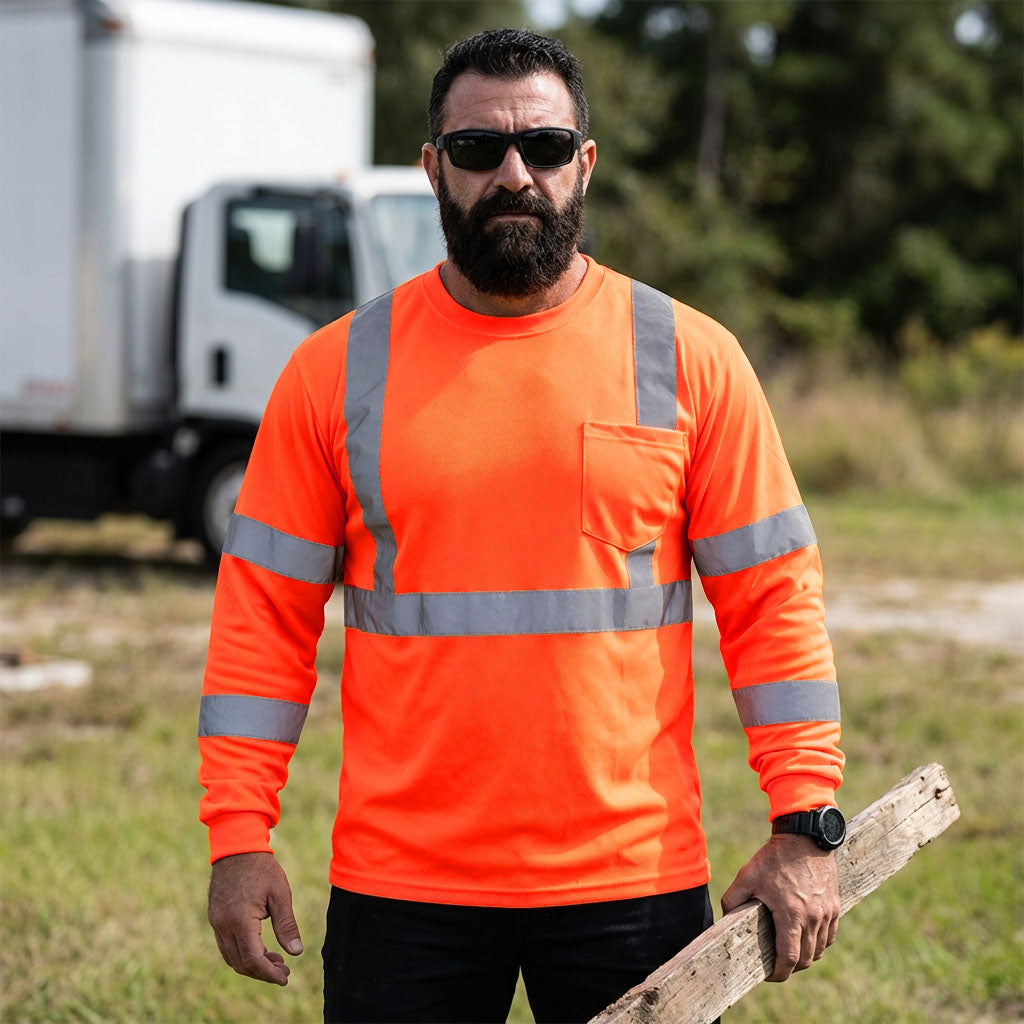
If your site requires ANSI Class 3, reflective material on the sleeves is part of the standard — a vest over a tee doesn't get you there. A rated long sleeve covers both problems at once. More on that in our Class 2 vs Class 3 breakdown.
What to look for
- 100% polyester or a poly-heavy blend. Cotton soaks, holds moisture against you, and takes forever to dry. Polyester wicks and dries. In heat this is the single biggest comfort factor.
- A relaxed cut. A long sleeve that clings defeats the purpose — you want a small air gap between fabric and skin for evaporation to work.
- Reflective tape on the sleeves, positioned above the elbow. Tape that sits right at the elbow crease cracks first.
- A front pocket. Sounds minor until you need somewhere for a pencil, a phone or a badge.
- Flatlock or well-finished seams. Shoulder seams that rub under a tool belt strap or a harness will find you by hour three.
Which shirt for which situation
For Class 3 compliance work
The High Visibility Safety Long Sleeve T-Shirt with Front Pocket is our most popular rated long sleeve — 100% polyester, reflective striping on torso and sleeves, available in ANSI safety green and safety orange.
When you want less fluorescent
The Long Sleeve Work T-Shirt with Front Pocket gives you reflective striping in standard colorways — a cleaner look for trades who don't need certified visibility but want to be seen.
For layering under outerwear
A long sleeve makes the right base under a Class 3 zip-up hoodie in shoulder season. Remember: whatever is on the outside carries the rating. See the full layering guide.
Browse the full range in Safety Shirts | Long Sleeve.
Practical habits that make long sleeves work in heat
- Own three or four, not one. A dry shirt in the truck at lunch changes your afternoon completely.
- Don't wear it tight. Size for airflow, not for looks.
- Cover the neck too. The back of the neck is the most-burned spot on most outdoor workers. A cap helps; a hooded option helps more.
- Wash without fabric softener. Softener coats polyester fibers and kills the wicking. This is the most common reason a good shirt stops performing.
- Retire faded shirts. Fluorescent fabric loses its daytime visibility as it fades, and the reflective tape degrades. A washed-out hi-vis shirt is a regular shirt.
Build the rest of the kit
- Short sleeve safety tees for the days you want them
- Safety vests to layer over anything
- Hats and caps for neck and face coverage
- ANSI hi-vis outerwear for when it turns
- Best sellers if you just want what works
Compartir:
Blank T-Shirts and Hoodies for Custom Printing: What to Look for Before You Order
What Is a Surveyor Vest? Class 2 Multi-Pocket Vests Explained