
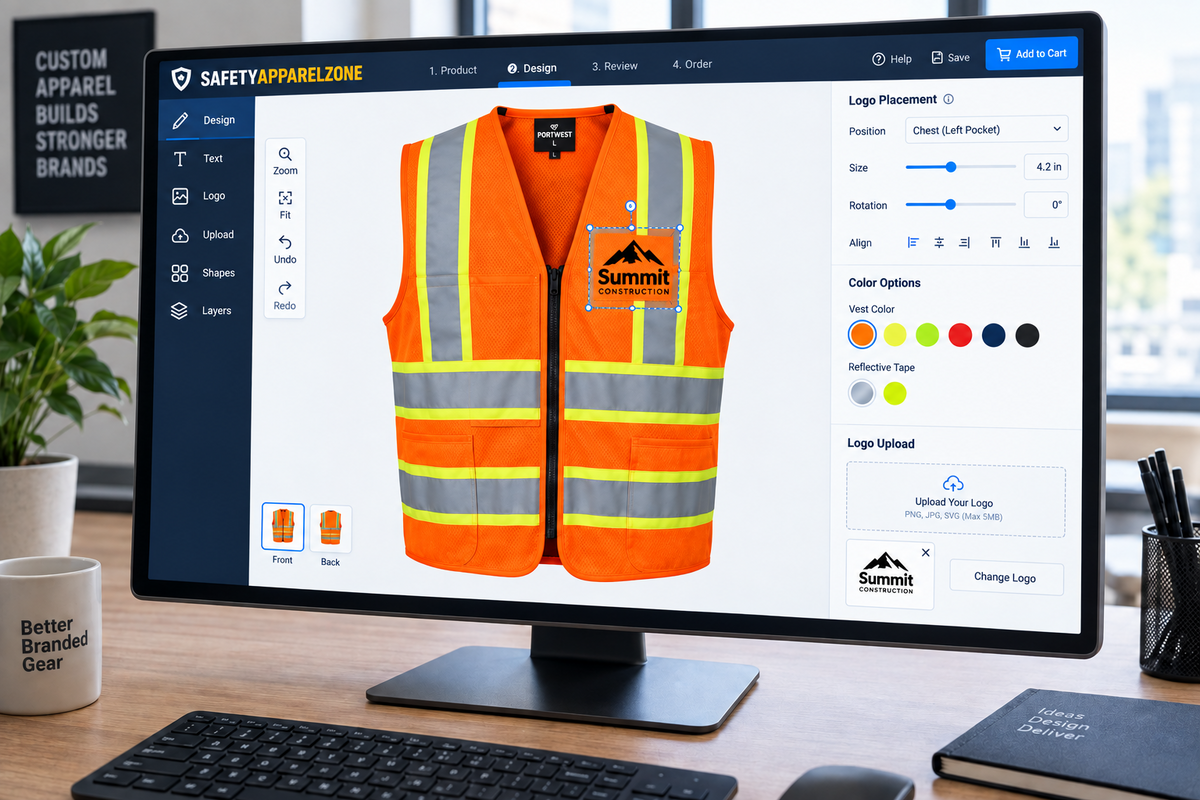
Quick answer: On a custom safety vest, put your logo on the left chest or pocket area and the upper back panel, and never print over the reflective tape. Leave about an inch of clearance around tape, zippers, pockets and seams. On ANSI-rated vests, keep the logo reasonably sized, because too much ink covers the fluorescent fabric the rating depends on. Solid-fabric panels print far better than open mesh.
A branded vest makes your crew look professional, helps customers and inspectors know who's who, and cuts down on vests "walking away." But a vest isn't a t-shirt. Where and how you print matters for both looks and compliance.
The best logo placements on a safety vest
| Location | Typical size | Good for | Watch out for |
|---|---|---|---|
| Left chest / above pocket | 3-4 in wide | Company logo | Pocket flaps, zipper, vertical tape |
| Upper back (above horizontal tape) | 8-11 in wide | Company name, "SUPERVISOR," phone number | Top edge of the tape band, shoulder seams |
| Lower back (below tape) | 6-10 in wide | Website or secondary text | Often hidden by tool belts and bending |
| Right chest | 3-4 in wide | Name or role | Radio clips and ID badges |
Rule #1: never print over reflective tape
Reflective tape works by bouncing headlight light straight back to the driver. Ink sitting on top of it blocks that. So a logo printed across the stripes doesn't just look off. It cuts the vest's night visibility right where it matters most. Keep all artwork on the fluorescent or solid fabric, with about an inch of breathing room around the tape.
Rule #2: on ANSI vests, don't overdo the logo
ANSI/ISEA 107 ratings depend on a minimum amount of visible fluorescent background fabric. Every square inch you cover with ink is fabric that's no longer fluorescent. A modest chest logo and a back print sized to the panel is normal. Covering the whole back in a dark design can push a vest below what it was certified for. Keep printed area modest, and if you need a big design, choose a bigger size class of garment (a Class 3 shirt or jacket has more fabric to work with) or a non-ANSI vest.
Rule #3: pick a vest with solid panels to print on
Open mesh has holes, and ink or a transfer has less to grab. Solid-front or solid-panel vests print far cleaner and last longer. Surveyor-style vests with a solid front and mesh back give you a clean chest print while staying cool.
- ANSI Class 2 Hi-Vis Vest with 4 Pockets: safety green or orange, knitted panels, 2-inch reflective stripes.
- ANSI Class 2 Multi-Pocket Vest: sizes XS-5XL.
- West Chester 47216 Surveyor Vest and PIP Eleven-Pocket Surveyor Vest: solid front, mesh back.
- Multi-Pocket Vest (non-ANSI colors): Red, Navy, Black, Royal Blue and more. There are no ANSI background limits, so it's great for bold branding where a rated vest isn't required.
Browse all vests in Safety Vests, and learn what surveyor vests are for in surveyor vests explained.
What ink colors work on safety vests
- Safety green and orange: black or navy reads best. Light colors and yellows vanish.
- Navy, black or royal non-ANSI vests: white or bright colors.
We tested it in what actually shows up on safety green and orange.
Heat-applied logos on polyester vests
Most vests are polyester, which is heat-sensitive. Heat-applied prints like DTF and vinyl need lower temperatures to avoid scorching or dye migration, and heat can damage reflective tape, so it should never be pressed. That's one more reason to keep artwork clear of the stripes. More in Custom T-Shirts & Merch Made Easy.
Custom vest checklist
- Confirm the ANSI class your site requires (Class 2 vs Class 3).
- Pick the color: lime vs orange.
- Choose a vest with solid print areas.
- Prep a clean file: transparent PNG or vector.
- Place the logo away from tape, zippers and pockets.
- Approve the mockup before anything is printed.
FAQ
Does adding a logo void ANSI compliance?
Not automatically. Logos are common on rated vests. The concern is covering too much fluorescent fabric or any reflective tape. Keep logos modest and off the stripes.
Can I print on the mesh part of a vest?
It can be done, but results are less crisp and less durable. Solid panels are strongly preferred.
Ordering vests for a whole company?
See building a company uniform program and our wholesale page.
Compartir:
How to Prepare Your Logo File for Custom Shirt Printing (So It Prints Right the First Time)