
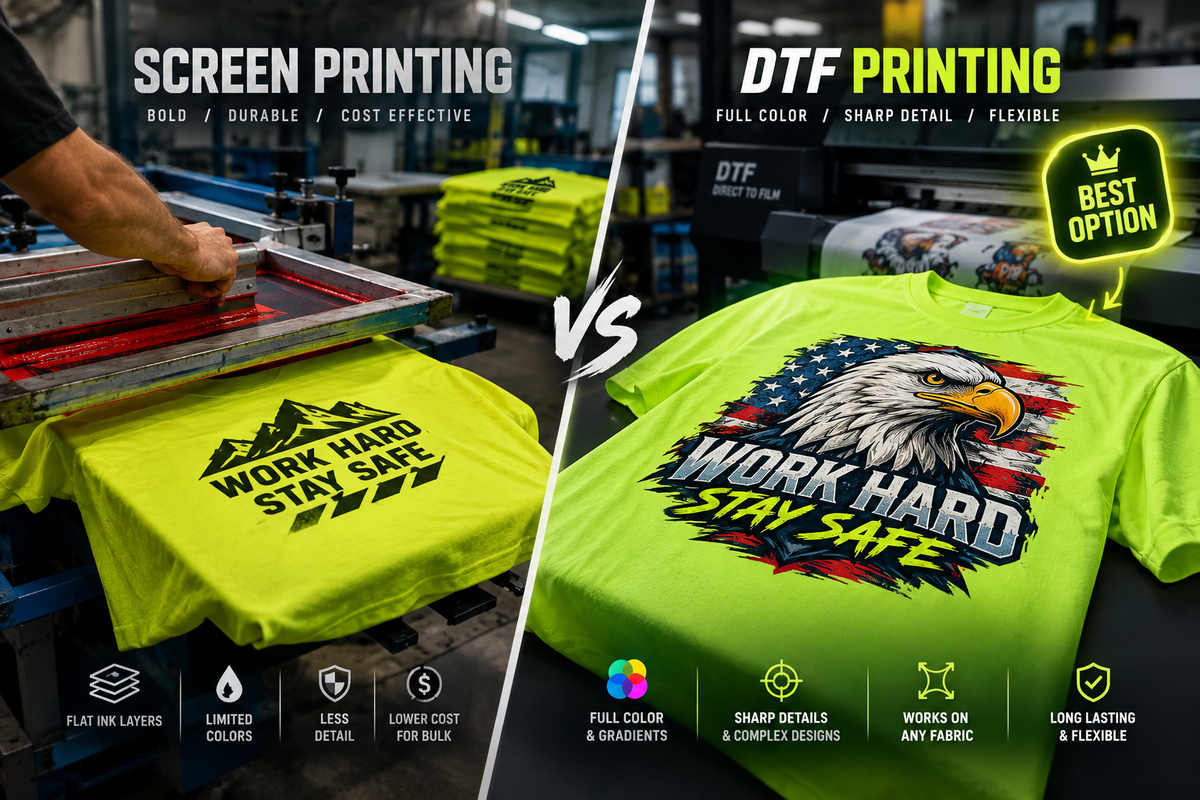
Quick answer: For small crew orders, like a handful to a few dozen shirts, full-color logos, or mixed sizes and colors, DTF (direct-to-film) is usually the better fit. There are no screens to set up, full color costs the same as one color, and it works on cotton, blends and most polyester. For big runs of the same simple 1-3 color design, usually 50-100+ pieces, screen printing gets cheaper per shirt and is extremely durable.
If you're ordering custom work shirts for your company, the print method affects price, look, feel and how long the logo lasts. Here's a no-nonsense comparison from a shop that sells blanks and custom workwear every day.
How each method works
Screen printing pushes ink through a mesh screen, with one screen per color, directly onto the shirt. Setup takes time, so the first shirt is expensive and every shirt after gets cheaper.
DTF (direct-to-film) prints your design onto a special film, coats it with an adhesive powder, then heat-presses it onto the garment. Because it's digital, a 10-color logo costs the same as a 1-color logo, and there's no setup per color.
DTF vs screen printing side by side
| DTF | Screen printing | |
|---|---|---|
| Best order size | 1 to ~100 pieces | ~50+ pieces of one design |
| Setup cost | None to minimal | Per color, per screen |
| Full-color and gradients | Easy, same price | Costly, each color adds a screen |
| Fabrics | Cotton, blends, most polyester, nylon | Best on cotton, poly needs special inks |
| Feel | Thin film on top of the fabric, smooth | Ink in and on the fibers, soft with plastisol or water-based |
| Durability | Very good when pressed correctly | Excellent, often outlasts the shirt |
| Mixed sizes and colors | No extra cost | Can add cost (different ink or underbase per shirt color) |
Which one should a small contractor choose?
- Crew of 5-25, full-color logo, mixed sizes: DTF.
- Company of 100+, one-color logo, same shirt: get a screen print quote, it'll likely win on price.
- Printing on polyester hi-vis or mesh: DTF is usually easier. Screen printing polyester needs low-bleed inks to avoid dye migration, where the fabric dye bleeds into the print.
- Re-orders a few at a time as you hire: DTF. No need to re-run screens for three new hires.
Special notes for printing on hi-vis
Safety green and safety orange change how logos look. Dark ink reads best, and some light colors disappear. We covered this in what actually shows up on safety green and orange. On ANSI-rated garments, never print over reflective tape. See our custom vest placement guide.
Picking the right blank for your print
- Jerzees 363M Safety Color Tee: 60/40 CVC blend in safety green and orange, with high stitch density for crisp prints.
- Jerzees 363M Basic Colors: 100% pre-shrunk cotton, the classic print tee.
- Jerzees 363L Long Sleeve, Safety Colors: for sun coverage.
- NuBlend Hooded Sweatshirt: 50/50 fleece that takes a big back print.
Browse the lineup in Jerzees Shirts. For a deeper look at fabrics, read what to look for in blanks for custom printing.
How custom printing works at Safety Apparel Zone
- Choose your shirt and the customization option on the product page, and upload your logo.
- We create a mockup and email it to you for approval before anything is printed.
- Prints are sized up to 12 inches wide by default. Want it smaller, like a left-chest logo? Just ask.
- We print your file exactly as submitted, so a clean, high-resolution file matters. Read how to prep your logo file first.
Ordering for a big crew? See what it costs to outfit a 12-person crew and our wholesale page.
FAQ
Does DTF crack or peel?
A properly pressed DTF transfer holds up very well. Wash inside out in cold water and tumble dry low to extend its life. Peeling usually means the transfer was under-pressed, not a flaw of the method.
Is DTF cheaper than screen printing?
For small quantities and full-color designs, usually yes. For large runs of simple designs, screen printing usually wins.
Can you DTF print on polyester work shirts?
Yes. DTF works on most polyester, but it needs the right temperature to avoid dye migration and scorching.
Share:
Custom Company Hoodies for Work Crews: Fabric, Fit and Logo Placement Guide