
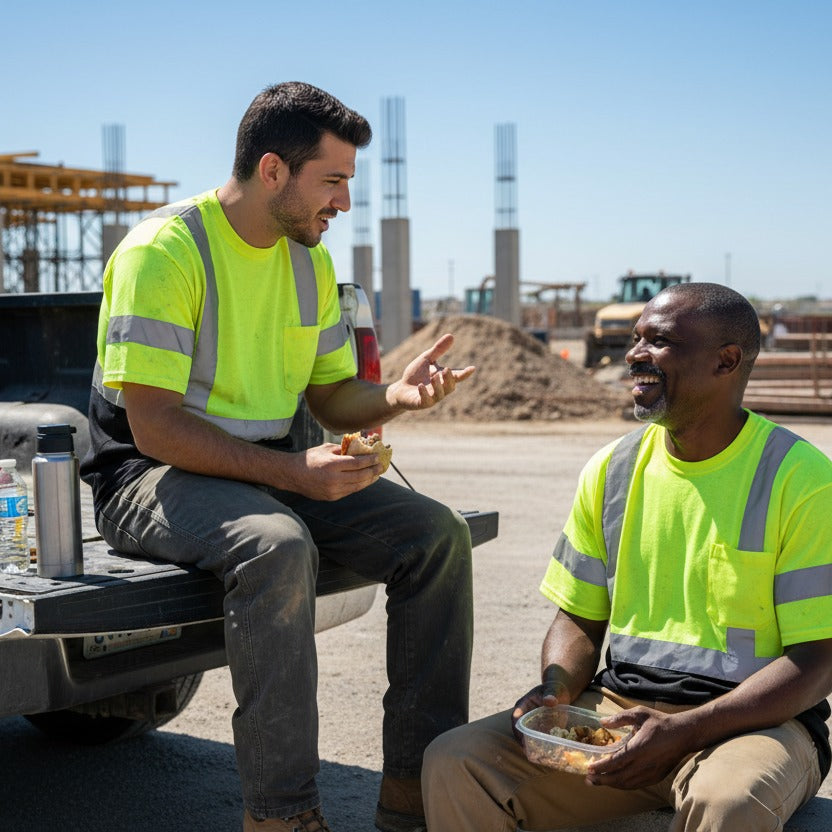
Nobody publishes this number, which is why it is so hard to budget for. Ask three suppliers what it costs to put a crew in branded shirts and you will get three quotes structured three different ways, none of which line up.
So here is the anatomy of the cost, using a twelve-person crew as the example. The dollar figures on your own order will vary, but the structure does not.
The four things you are paying for
1. The blank garment
This is the shirt itself before anything is printed on it. It is the only line item most people think about, and it is usually the smallest lever on the total.
The thing that moves this number is quantity, not shirt selection. Stepping from a mid-weight blank to a heavier one might change your per-piece cost by a dollar. Crossing a quantity threshold changes it by a great deal more. On our daily basics range, six pieces takes 12% off and twelve pieces takes 24% off, applied automatically. For a twelve-person crew that second tier is right there, which is worth knowing before you order eleven shirts.
2. The print charge
This is priced per location, per color, per piece. Three variables, and each one is a place your quote grows:
- Locations. Left chest only is one location. Left chest plus full back is two, and roughly doubles the print cost.
- Colors. Screen printing needs a separate screen per ink color. A one-color logo is meaningfully cheaper than a four-color one, every single time you reorder.
- Quantity. Print gets cheaper per piece as the run grows, because setup is spread across more shirts.
The single biggest saving available to most small crews is going to a one-color logo. If your brand mark can survive being solid black, take that option. It costs less on this order and on every order after it.
3. Setup or screen fees
Many printers charge a one-time setup per screen. On a twelve-piece run this can be a surprisingly large share of the total, because you are spreading a fixed cost across very few shirts. It is also why a twelve-piece order and a fifty-piece order can have wildly different per-shirt prices for identical artwork.
Worth asking any supplier: is setup charged again on a reorder of the same artwork? Some hold your screens, some do not. Over a couple of years that difference adds up.
4. Shipping
Freight varies too much by weight, destination, and speed to be baked into a quote honestly, which is why we quote it separately rather than pretending it is free. It is not usually the largest line, but it is not zero, and a supplier who tells you shipping is free has priced it into something else.
Where the money actually gets wasted
Two mistakes account for most of the overspend we see.
Ordering just under a quantity break. Ordering eleven shirts instead of twelve to save money is a false economy when twelve unlocks a deeper discount. Run the total both ways before you commit. The twelfth shirt frequently costs less than nothing.
Guessing on sizes. Ordering an even spread across S through 3XL because it feels safe leaves you with shirts nobody wears and a reorder for the sizes you actually needed. Ask the crew. It takes one text message and it is the highest-return ten minutes in the whole process.
How many shirts per person
For a crew working outdoors five days a week, three to four shirts per person is the practical number. That covers a normal laundry cycle without anyone wearing the same shirt twice in a week. Two is too few and creates fast wear on both. Our rotation guide goes into this in more depth.
Note what this does to your math: a twelve-person crew at three shirts each is thirty-six pieces, not twelve. That puts you well past the top quantity tier and changes the per-shirt economics considerably. If you are budgeting, budget for the rotation rather than for headcount.
Safety colors versus ANSI rated
This is a real cost decision, not just a spec detail. An ANSI 107 certified garment carries reflective tape and meets background material requirements, and it costs more than a safety-color blank. If your general contractor, your DOT contract, or your site rules require a class rating, you need certified gear and there is no way around the cost.
If nobody is requiring a class and you want your crew visible and branded, safety-color blanks do the job for less. Our Class 2 versus Class 3 guide covers which situations genuinely require certification.
Getting a real number
To get a quote that is not a guess, a supplier needs four things from you: the garment and color, the size breakdown, the number of print locations, and the number of ink colors. Have those ready and you will get an accurate figure in one exchange instead of four.
For larger orders, our wholesale page takes the same details and comes back with a quote. Shipping is quoted separately, because it genuinely varies.
Share:
Reflective Neck Gaiters: UPF 50+ Sun and Wind Protection for the Jobsite
Hats & Caps for the Jobsite: Trucker Hats, Ball Caps, and Sun Protection Options