
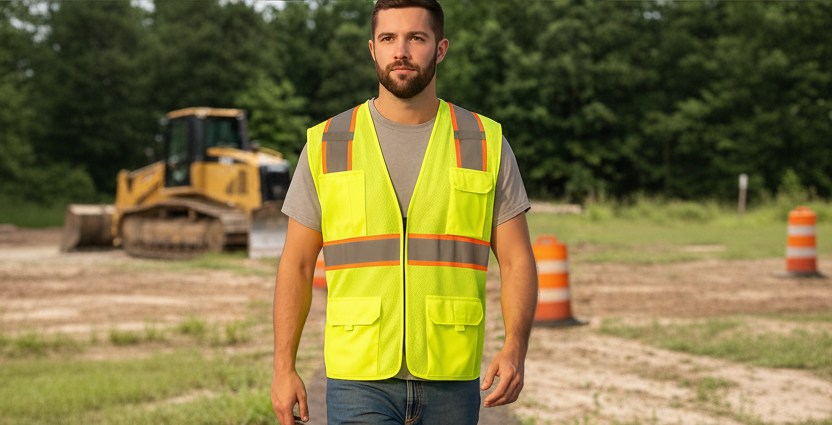
ANSI 107 Explained: What Class of Hi-Vis Shirt Do Construction Workers Really Need?
If you work around moving equipment or traffic, you already know one thing: if drivers and operators can’t see you, they can’t avoid you.
That’s exactly what the ANSI/ISEA 107 standard is about—making sure your hi-vis gear is bright and reflective enough for the hazards around you. But between Types, Classes, and all the options (shirts, vests, jackets, pants), it’s easy to wonder:
What class of hi-vis shirt do construction workers really need?
This guide from Safety Apparel Zone breaks it down in plain English, so you can:
- Pick the right ANSI class for your crew and jobsite
- Stay aligned with FHWA and OSHA expectations
- Avoid wasting money on gear that’s overkill or not compliant enough
Quick answer: Most road and construction crews need at least Type R, Class 2
If you just need the short version:
-
On or near public roads, around moving traffic:
- Minimum: Type R, Class 2 hi-vis shirt or vest
- Better for night, high speeds, or bad weather: Type R, Class 3
-
On private construction sites away from public traffic but with heavy equipment:
- At least Type O, Class 1, but many safety programs standardize on Type R, Class 2 for extra protection.
If you’re ready to shop compliant options, you can browse:
What ANSI/ISEA 107 actually is (without the legal speak)
ANSI/ISEA 107 is the U.S. standard that defines performance requirements for high-visibility safety apparel. Learn more at the OSHA PPE official page.
It answers three main questions:
- How bright does the background fabric have to be?
- How much reflective tape do you need, and where does it go?
- What garment designs work for different work environments?
The standard uses:
- Types to describe where you’re working
- Classes to describe how visible you need to be
ANSI “Type”: Where you work
Type O (Off-road)
“Off-road” work zones away from public traffic — inside large industrial plants, warehouses with forklifts, or logging and mining sites without public traffic.
Type R (Roadway)
Workers exposed to moving traffic on public roads or highway rights-of-way — road and bridge construction, utility crews on shoulders or medians, flaggers and traffic control.
Type P (Public Safety)
Police, firefighters, EMS — people doing emergency or public safety work close to traffic.
For most construction and road crews, Type R is the default.
ANSI “Class”: How visible you need to be
- Class 1 – Lowest visibility, small amounts of fluorescent and reflective material
- Class 2 – More coverage; standard for many roadway workers
- Class 3 – Maximum coverage and visibility, especially in low light or high-speed traffic
The higher the class, the easier you are to see from farther away and under worse conditions.
What does that mean for hi-vis shirts?
Hi-vis shirts can be part of a Class 2 system (for example: a Class 2 vest worn over a non-ANSI shirt), or designed to meet Class 2 or Class 3 on their own.
The safest approach for most construction workers:
- Daytime road or construction work near >25 mph traffic: At least Type R, Class 2 gear from our Hi-Vis Shirts Collection or Safety Vests Collection
- Night work, highway speeds, or complex environments: Upgrade to Type R, Class 3 from our Hi-Vis Outerwear Collection
Common construction scenarios and what class they point to
Scenario 1: Daytime residential street repaving
Speed: 25–35 mph | Work: Milling, paving, flagging | Traffic: Local cars and trucks
Recommended: Type R, Class 2 shirts or vests for the whole crew. Consider Class 3 for flaggers or anyone standing in live lanes. Browse options in our Safety Vests Collection and Hi-Vis Shirts Collection.
Scenario 2: Highway bridge repair with lane closures at night
Speed: 55–70 mph | Work: Demolition, formwork, lane shifts | Traffic: Heavy volume, headlight glare
Recommended: Type R, Class 3 hi-vis shirts or jackets for everyone exposed to traffic. Layer with Class 3 outerwear from our Hi-Vis Outerwear Collection during cold or wet weather.
Scenario 3: Large private site with heavy equipment but no public traffic
Speed: Mostly <25 mph | Work: Earthmoving, foundations, utility installation | Traffic: Internal site vehicles only
Minimum: Type O, Class 1. Better practice: standardize on Type R, Class 2 hi-vis shirts or vests from our Hi-Vis Shirts Collection and Safety Vests Collection for more visibility and consistency.
Shirts vs. vests vs. outerwear: what “counts”?
ANSI 107 doesn’t care which garment provides the visibility—only that the total system meets the right Type and Class.
- Option 1: Hi-vis shirt + non-ANSI vest — The shirt does the heavy lifting (if it’s designed to be ANSI-compliant). Browse our Hi-Vis Shirts Collection.
- Option 2: Non-ANSI shirt + Class 2 or 3 vest — The vest provides the required background and tape. Browse our Safety Vests Collection.
- Option 3: Hi-vis shirt + hi-vis vest + hi-vis outerwear — In cold or wet conditions, use compliant hoodies/jackets from our Hi-Vis Outerwear Collection.
Important: Dark outerwear or sweatshirts worn on top of hi-vis cancel out your visibility. In cold weather, pick hi-vis hoodies and jackets with reflective tape so your outer layer still meets the standard.
How to choose the right class for your crew (step-by-step)
- Are you working on or near public roads? Yes → Type R. No, only inside a plant or private site → Type O may be allowed, but Type R is often safer.
- What is the typical speed of nearby vehicles? Under ~25 mph → Class 1 minimum, but Class 2 is safer. 25–50 mph → Class 2 minimum. Over 50 mph → Class 3 strongly recommended.
- Are you working at night, in fog, rain, or low light? Yes → Move up to Class 3. No → Class 2 is often sufficient.
- Do workers wear outerwear often? Yes → Make sure outer layers are hi-vis and ANSI-compliant from our Hi-Vis Outerwear Collection.
Typical setups that work well
Basic construction / road crew (daytime, up to 45 mph)
- Type R, Class 2 hi-vis shirt from our Hi-Vis Shirts Collection
- Or non-ANSI work shirt + Class 2 vest from our Safety Vests Collection
High-speed or night work
- Type R, Class 3 long-sleeve shirt or jacket from our Hi-Vis Outerwear Collection
- Or Class 2 shirt + Class 3 jacket that together provide full Class 3 coverage
Private industrial site with forklifts and yard trucks
- At least Type O, Class 1 hi-vis shirts or vests
- Many sites choose Type R, Class 2 from our Hi-Vis Shirts Collection and Safety Vests Collection for extra visibility and consistency
What to avoid when buying hi-vis shirts
- No ANSI reference in the product description — If it doesn’t say ANSI/ISEA 107 (and a Type/Class), it’s probably not compliant.
- Fashion hi-vis — Bright colors without proper reflective tape and coverage won’t meet standards.
- Dark outerwear covering hi-vis — Makes your ANSI-compliant shirt invisible from a distance.
- Buying only one shirt per worker — Sweat, dirt, and wear quickly reduce visibility—plan for multiple shirts per person from our Hi-Vis Shirts Collection.
Final checklist: What class should you choose?
Ask yourself:
- Do we work around public traffic over 25 mph?
- Do we work at night or in poor weather often?
- Are workers sometimes in and out of vehicles, with limited reaction time from drivers?
If yes to any of these:
- Minimum: Type R, Class 2
- Safer (especially for highways, night, or flaggers): Type R, Class 3
You can outfit your crew with compliant gear today using:
At Safety Apparel Zone, our goal is simple: help you choose gear that makes sense for the real risks you face, so everyone can go home safe at the end of the shift.
Share:
Hi-Vis Work Shirts: Stay Seen, Stay Safe on the Job
Hi-Vis Shirts for Summer: How to Stay Cool and Compliant on Hot Job Sites